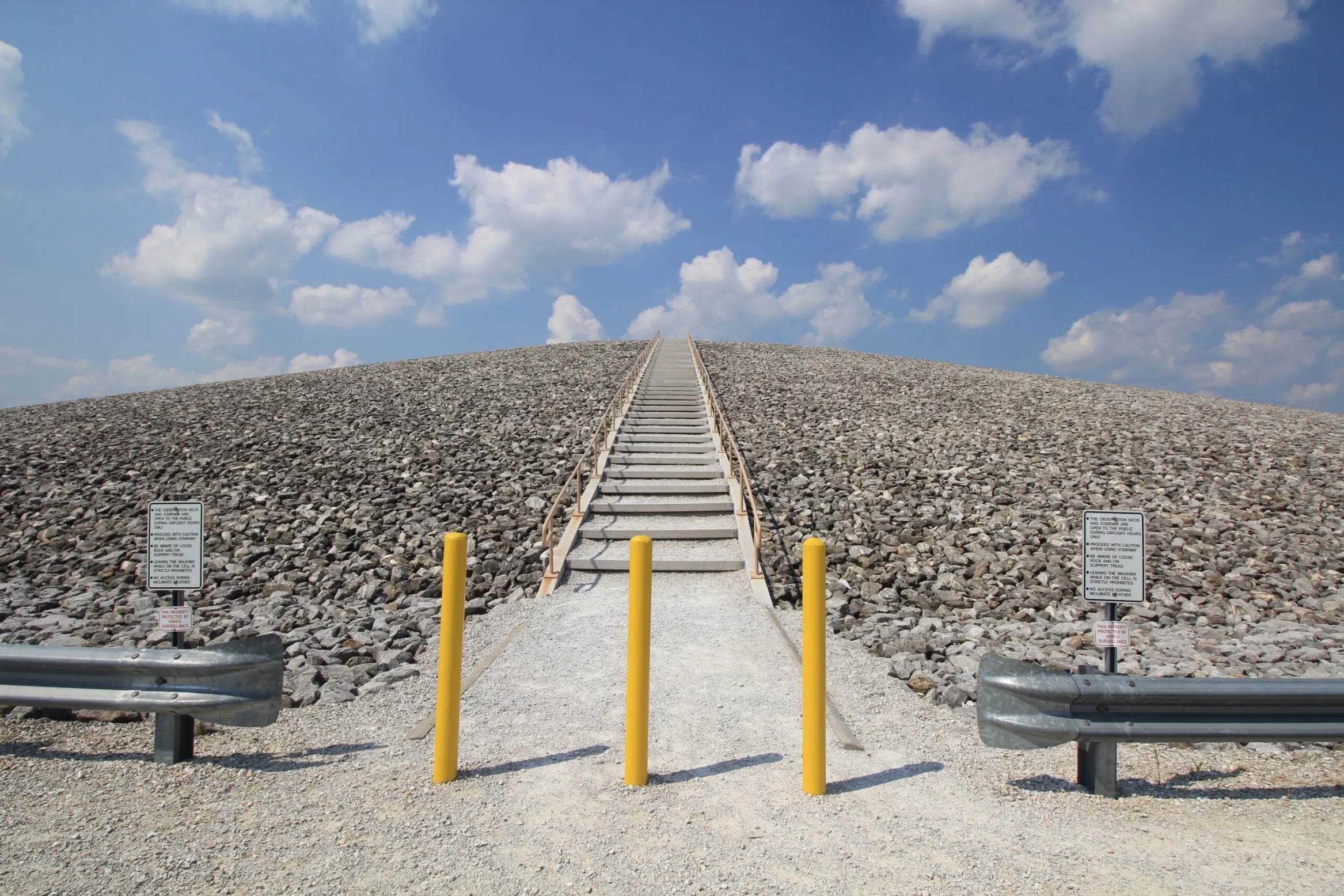
This month’s calendar features the Weldon Spring Site and Interpretive Center. Specifically, the featured image is the entrance to take the steps to the top of the site for an interesting panoramic view of the area.
The U.S. government acquired 17,232 acres of rural land, displacing 576 residents and three towns to establish the Weldon Spring Ordnance Works supporting World War II efforts for manufacturing TNT and DNT.
TNT Marker noting the displacement of residents.
From 1956 – 1967, the U.S. Atomic Energy Commission constructed the Weldon Spring Uranium Feed Materials Plant to convert uranium ore concentrates to pure uranium oxides and compounds. Obviously, by 1987, with production ceasing, the DOE was left with a massive Superfund cleanup site.
Weldon Spring disposal cell structure from afar.
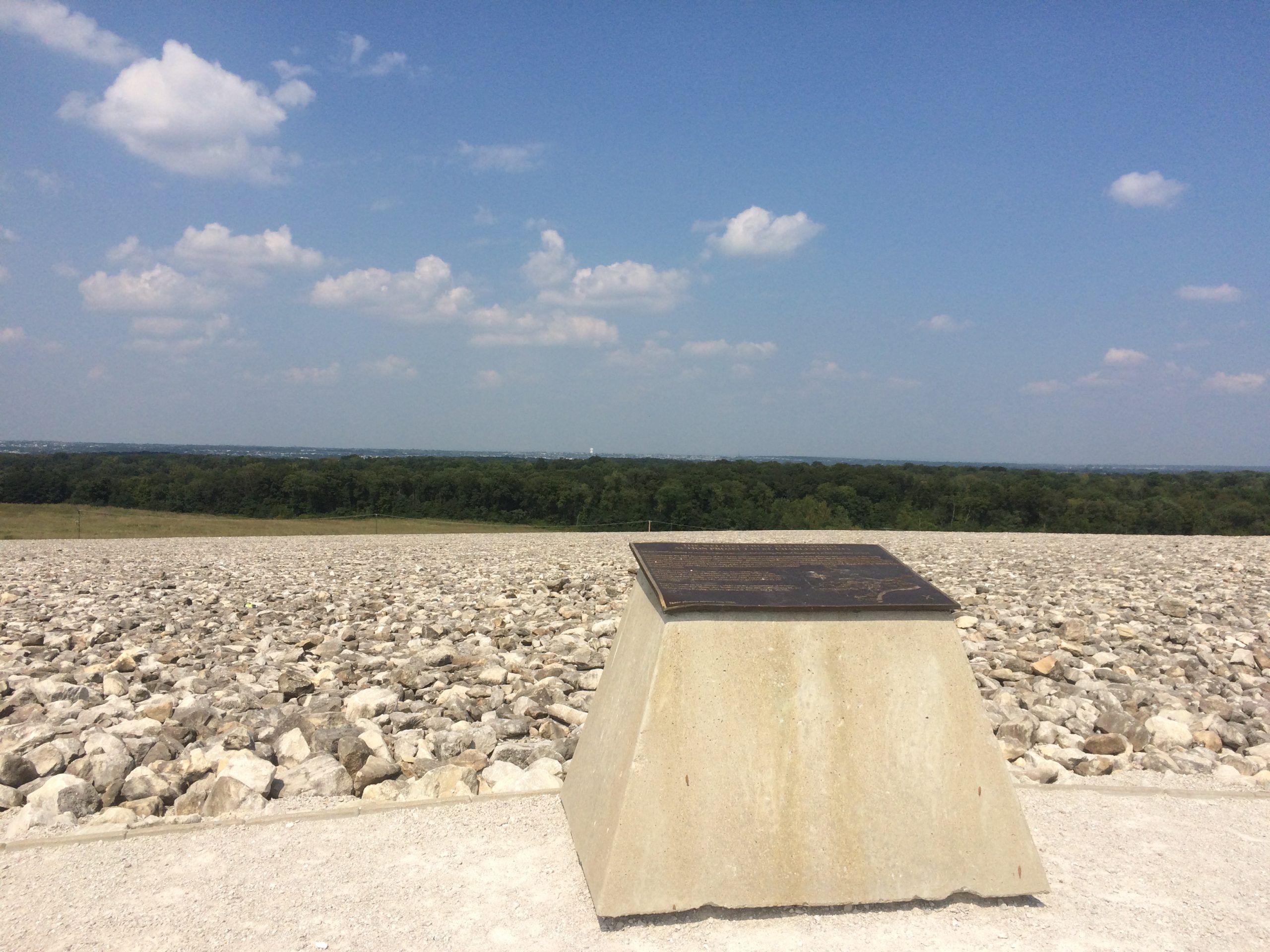
The outstanding feature of the Weldon Spring Site is the 41 acre, 75 foot tall engineered disposal cell structure designed to contain the site’s waste. Now a public park with walking trails, bird watching, mountain biking, and native, restored prairie, the disposal cell stairway takes you to the top of the mound with a panoramic view of the area with historical markers.
Weldon Spring Marker at the top of the disposal cell.
Be sure to go to the Interpretive Center that explains more about the area, the TNT manufacturing, the Atomic Energy Commission’s use for uranium materials, and the Department of Energy cleanup.
Weldon Spring Site and Interpretive Center, Saint Charles, MO.
Be sure to download the October 2025 calendar featuring significant atomic events and atomic shots occuring during the month of October.
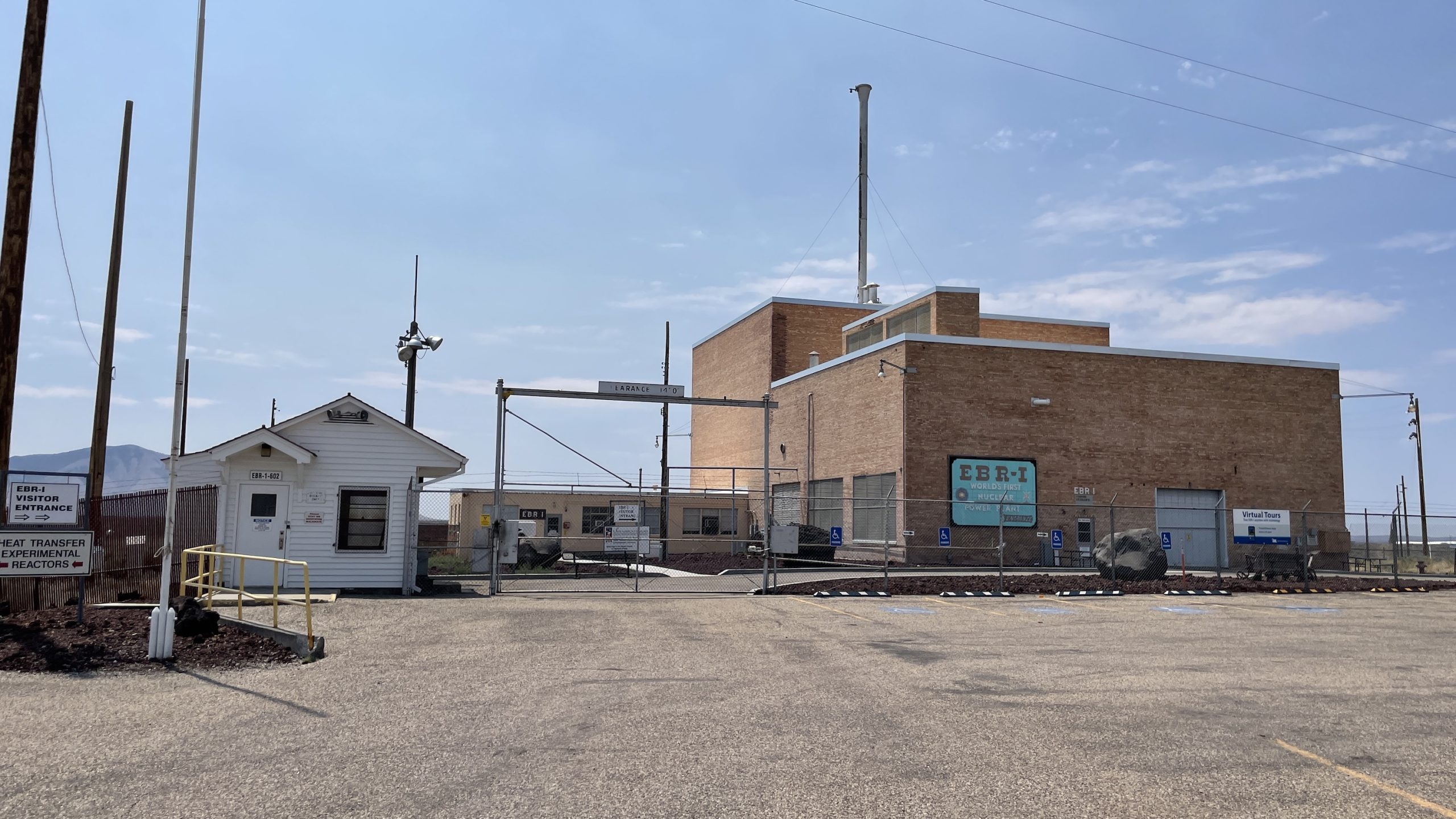
This month’s calendar features the Experimental Breeder Reactor I (EBR-1) which is just a short drive from Arco, Idaho, across from the Idaho National Laboratories.
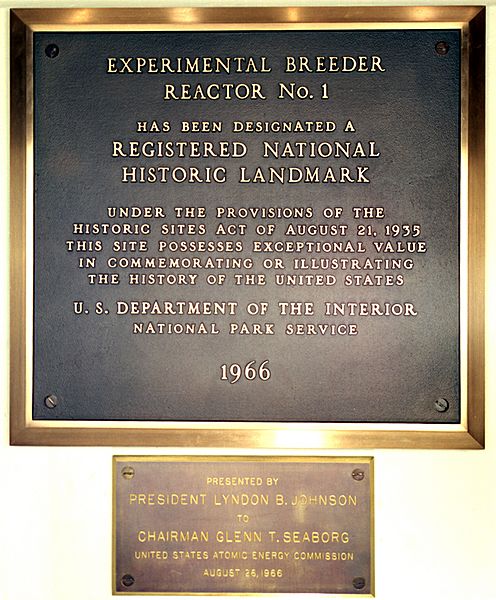
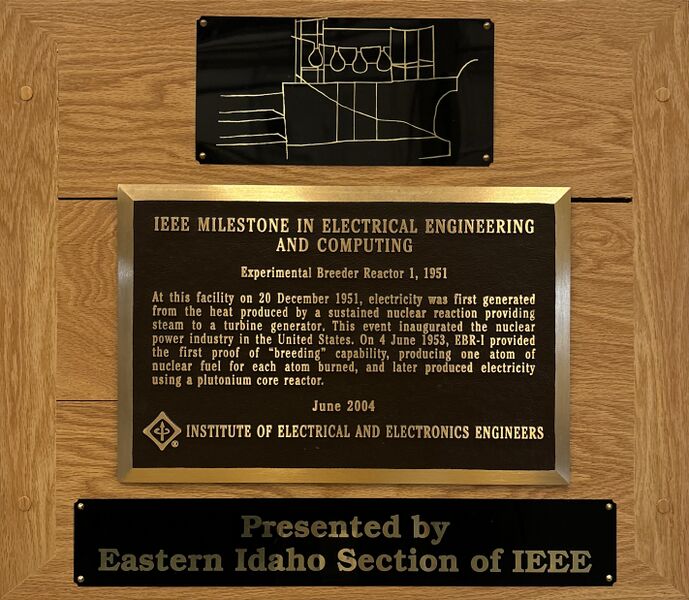
EBR-I began power operation on August 24, 1951, and was decomissioned in 1964. It was dedicated as a Registered National Historic Landmark on August 25, 1966, by President Lyndon Johnson and Glenn Seaborg, chairman of the Atomic Energy Commission. On June 4, 2004, the Institute of Electrical and Electronics Engineers (IEEE) dedicated the facility as a Milestone in Electrical Engineering and Computing.
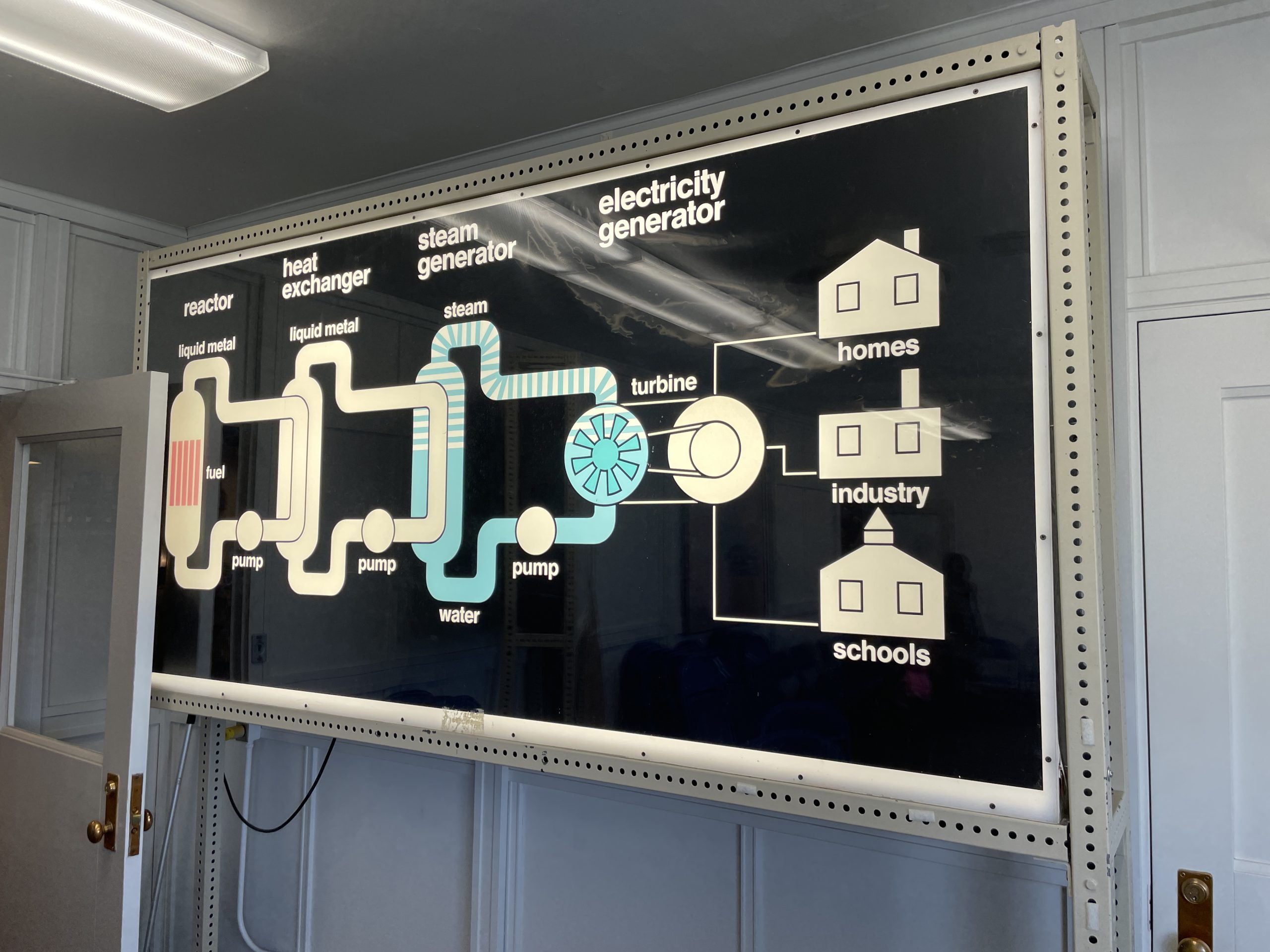
EBR-1 was the first operating breeder reactor, which produces more fuel for the fission process than it consumes. The breeding process involved converting uranium-238 into plutonium via fast neutrons. This then heated a liquid metal (sodium-potassium alloy) through a heat exchanger for coolant, in turn heating water into steam for turbine electrical generation.
The reactor was completed in 1951, and on December 20, 1951, it became the world’s first nuclear power plant, generating enough electricity to power four 200-watt light bulbs.
EBR-1 Generator with replicas of the four 200-watt light bulbs.One of the four original light bulbs lit by nuclear power on December 20, 1951.
EBR-1 is a museum in which visitors can wander throughout the building on a self-guided tour (May through September) to see various exhibits and information about the breeder reactor. These two exhibits note that on December 21, 1951, all of the electrical power in the building was supplied by atomic energy.
Be sure to download this month’s calendar featuring significant atomic events from 1933 to 1994 as well as 80 atomic shots conducted during September since 1945, including the last nuclear shot on September 23, 1992 (Julin: Divider).
August 6, 2025, marks the 80th anniversary of the atomic bombing of Hiroshima, followed by the bombing of Nagasaki on August 9.
From Hiroshima to Hope is a nonprofit organization in Seattle, WA, dedicated to commemorating the victims of the atomic bombings of Hiroshima and Nagasaki and all victims of war and violence. Each year on August 6, the organization sponsors an event at Green Lake, Seattle, that includes speakers, music, dance, art, and lantern floating (Toro Nagashi).
Kintsugi Somatic Art Heron Dancers
The Heron Siege Peace Procession is inspired by peace dances at Buddhist Temples in Asakusa Tokyo. The costumes were designed by artist Chantal Uto. A siege is a persistent effort to overcome; it is also the name of a group of herons. Hence, herons are a symbol of perserverance. The Kintsugi Somatic Art group is encouraging perserverance for peace.
Blades of Change, “The Wild Rose of Hiroshima”
Blades of Change is an equitable arts and community storytelling initiative transforming industrial nuclear fan blades into monumental canvasas for artists. The nuclear fan blads (6×4 feet) originated at the never-completed Satsop Nuclear Power Plant in Elma, WA.
“The Wild Rose of Hiroshima” is etched with paper cranes and crowned in native plants from Wanapum land. The wild rose is a symbol of protection and cleansing. The figure honors Sadako Sasaki and contains further images that link Hiroshima and Hanford, WA. This blade was created by Lauren Iida and Johnny Buck.
“Little Boy” sculpture and organization banner.
Yukiyo Kawano is a third generation hibakusha (nuclear bomb survivor). In her sculpture “Little Boy (folded)”, ishe has sewn silk kimono fabric with strands of her hair (to include her DNA as a third generation hibakusha) to form a suspended full-scale sculpture of Little Boy, the atomic bomb dropped on Hiroshima.
Floating lanterns
The lantern floating ceremony is an adaptation of an ancient Japanese Buddhist ritual, the Toro Nagashi, in which lanterns representing the spirits of the dead are floated out to sea and prayers are offered that they might rest in peace. The ceremony is in remembrance of the victims of the atomic bombings. In Seattle, the lanterns have come to represent not only those victims but also those who have died in violent conflict anywhere. The calligraphers of Beikoko Shodo Kenkyukai prepared many lantern sleeves with words of remembrance, peace, and hope.
The procession to launch the lanterns in Green Lake, Seattle, WA, was led by Norimitsu Tosu, a hibakusha (survivor of the Hiroshima atomic bomb). Mr. Tosu and his son, Fumiaki Tosu, brought a young adult pilgrimage (The Fierce Nonviolence Pilgrimage) from Spokane focused on nonviolence and nuclear abolition.
Volunteers launched the floating lanterns into Green Lake, Seattle, WA, on the public dock on behalf of the attendees.